'In honour of God and of Saint Cuthbert'
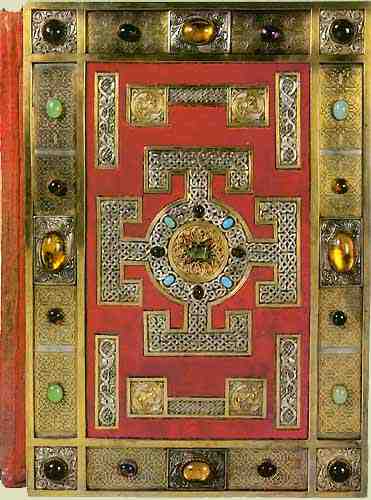
Lindisfarne Gospels
Holy Island has a very special place in history
as the birthplace of the Lindisfarne Gospels, among the most
celebrated illuminated books in the world.
According to an inscription added in the 10th century at the end of the original text, the manuscript was made in honour of God and of St. Cuthbert by Eadfrith, Bishop of Lindisfarne, who died in 721.
Eadfrith played a major part in establishing Cuthbert's cult after his relics had been raised to the altar of the monastery church on 20th March, 698, the eleventh anniversary of his death. The Gospels may have been made in honour of that event.
According to an inscription added in the 10th century at the end of the original text, the manuscript was made in honour of God and of St. Cuthbert by Eadfrith, Bishop of Lindisfarne, who died in 721.
Eadfrith played a major part in establishing Cuthbert's cult after his relics had been raised to the altar of the monastery church on 20th March, 698, the eleventh anniversary of his death. The Gospels may have been made in honour of that event.
The book's original leather binding was provided
by Ethelwald, who followed Eadfrith as bishop and died about 740. He had
been associated with Cuthbert in his lifetime. An outer covering of
gold, silver and gemstones was added by Billfrith the Anchorite,
probably about the middle of the 8th century.
Both covers have long since vanished but the manuscript itself has survived the thirteen centuries associated with Cuthbert's relics at Durham during the Middle Ages and preserved from destruction after the Reformation through the scholarly interest of Tudor antiquaries.
The Lindisfarne Gospels is now part of the collection of Sir Robert Cotton, (d. 1631), in the British Library in London, where it is seen by visitors from all over the world.
Both covers have long since vanished but the manuscript itself has survived the thirteen centuries associated with Cuthbert's relics at Durham during the Middle Ages and preserved from destruction after the Reformation through the scholarly interest of Tudor antiquaries.
The Lindisfarne Gospels is now part of the collection of Sir Robert Cotton, (d. 1631), in the British Library in London, where it is seen by visitors from all over the world.
We are indebted to the late Janet Backhouse who supplied the text for our Gospel Page and gave
permission to use the images in her book "The Lindisfarne Gospels" published in association
with The British Library by Phaidon, Oxford - ISBN 0 7148 2148 9.
Available from: