"Come to me, all who are weary and whose load is heavy - I will give
you rest." - Matthew 11-28
Holy Island
Castle, Priory, Harbour and Religious Past
 LINDISFARNE CASTLE
The castle is managed by the National Trust and maintained to a very
high standard indeed. The view from the top is truly magnificent -
it is also unique... Sited atop the volcanic mound known as
Beblowe Craig, Lindisfarne Castle is one of the most distinctive and
picturesque features of the Island and can be seen for many miles
around.
LINDISFARNE CASTLE
The castle is managed by the National Trust and maintained to a very
high standard indeed. The view from the top is truly magnificent -
it is also unique... Sited atop the volcanic mound known as
Beblowe Craig, Lindisfarne Castle is one of the most distinctive and
picturesque features of the Island and can be seen for many miles
around.Following the dissolution of the monasteries by Henry VIII, it was built in 1550 in defence of the realm against attack by Scotland and in pursuit of their Spanish allies. Interestingly, it is said to be constructed from stone taken from the Priory. This seems to contradict that we know that the Priory remained standing until well into 17th century when it collapsed through neglect. Furthermore, the number of stones comprising the castle is considerable compared to those that would have been available on priory site.
A most interesting recent feature (1997) has been the re-facing of north-facing walls which featured the use of Yak hair in the render. The hair was apparently introduced to reduce erosion to the walls caused by rain water running down the sheer faces.
During 2017 the National Trust regret that they have been forced to close the castle whilst vital restoration work takes place.
When visiting the castle area of the Island, do also visit the Lime Kilns which are situated under the eastern embankment. Up until the turn of the last century slaked lime featured highly in the Island's economy. The well-formed, Victorian, kiln arches are best viewed from the adjacent beach.
 LINDISFARNE PRIORY The building of the world renowned famous
Benedictine Priory was started during the late 11th century and
followed on from the Norman conquest and ensuing religious changes.
It was built in a parallel time frame and regarded by many as 'the
taster' for the building of Durham Cathedral. The scale is about
10-to-1 and, although in the case of Lindisfarne there has been
considerable erosion to the interior Romanesque stonework, the
features are identicical between the two - even to the extent of the
gothic chancel extension.
LINDISFARNE PRIORY The building of the world renowned famous
Benedictine Priory was started during the late 11th century and
followed on from the Norman conquest and ensuing religious changes.
It was built in a parallel time frame and regarded by many as 'the
taster' for the building of Durham Cathedral. The scale is about
10-to-1 and, although in the case of Lindisfarne there has been
considerable erosion to the interior Romanesque stonework, the
features are identicical between the two - even to the extent of the
gothic chancel extension.The Priory appears not to have been built on the site of the Irish monastery founded by St.Aidan in 635a.d.. (The monastery site is taken to be ground occupied by the chancel of the local parish church of St.Mary.) The Priory was founded on the ground immediately to the east of the church where, late in the 7th century, the church of St.Peter stood. Significantly, several of our 'Northern Saints' were interred within this ancient church - including the famous Saint Cuthbert.
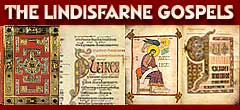
With, what must be regarded as, 'cutting edge' skills of their time the magnificent 'Lindisfarne Gospels' were produced here. It is surprising that from such a gifted, Celtic-Christian community hardly anything else has been discovered from this earlier period. But judging by the elaborate debris found amongst the priory foundations the new landlords seem to have gone to a great deal of trouble to remove all traces of the old order. Some of these priceless relics can be seen in the nearby English Heritage museum.
The Norman Priory was undoubtedly, even for its time, a great feat of civil engineering. There are many unique features for the visitor to discover and it is certainly well worth spending some time in the museum. And while you are here, do have look around our Parish Church. Look out for the traces of Saxon architecture. Sense for yourself the presence of its 7th century past.
 HOLY ISLAND HARBOUR
Holy Island harbour is characterised world-wide by pictures of the
large, upturned fishing boats lining the beach. Now no longer
seaworthy and used as work sheds for the small remaining seagoing
fraternity, many of these boats were part of one of the largest
Herring Fleets to sail off the east coast of England.
HOLY ISLAND HARBOUR
Holy Island harbour is characterised world-wide by pictures of the
large, upturned fishing boats lining the beach. Now no longer
seaworthy and used as work sheds for the small remaining seagoing
fraternity, many of these boats were part of one of the largest
Herring Fleets to sail off the east coast of England.The fishing fleet operated from Holy Island harbour up until the turn of the 19th century. It is often claimed (and even more often contested with nearby Craister!) that the first oak-smoked Herring was prepared in the adjacent Herring curing sheds - converted now to the Herring Houses.
In more ancient times, naval documents record that the English fleet berthed here and sailed out of the ancient Northumbrian capital when Bamburgh too was an island way back in the 11th century.
Whilst making for a lovely, tranquil stroll on a Summer evening, the views from the harbour of the tremendous seas breaking over the other Farne islands during severe Winter gales are absolutely stunning - particularly knowing that one can then return to the comfort and warmth of one of the local friendly hostelries.
 RELIGIOUS HISTORY
During the 7th century and at the request of King Oswald, the
missionary community of Iona were invited to introduce Christianity
into northeast England. Under Oswald and this Celtic influence
Northumbria became the mightiest of all English Kingdoms.
RELIGIOUS HISTORY
During the 7th century and at the request of King Oswald, the
missionary community of Iona were invited to introduce Christianity
into northeast England. Under Oswald and this Celtic influence
Northumbria became the mightiest of all English Kingdoms.Choosing to settle on Lindisfarne, the Celtic Christian influence which swelled down into England surpassed even that of Canterbury for quite some time. There remain many communities all over the world who have drawn inspiration from the religious teachings and doctrine of Lindisfarne. Even today there are many who make their joint or private pilgrimage to our ancient shores. For those prepared to heed the call of the Island, the spark that set all those fires alight throughout the ages, is still here and burning even stronger - not only for Christians but for people of all creeds.
For more information on our religious history please visit the following web pages: