'In honour of God and of Saint Cuthbert'
Late classical influence from the Mediterranean
is blended with celtic motifs and Germanic animal ornament to produce
a distinctive and satisfying whole, characterising Eadfrith as an
accomplished and imaginative craftsman who exercised the full range of
his talents in celebration of his Christian faith.
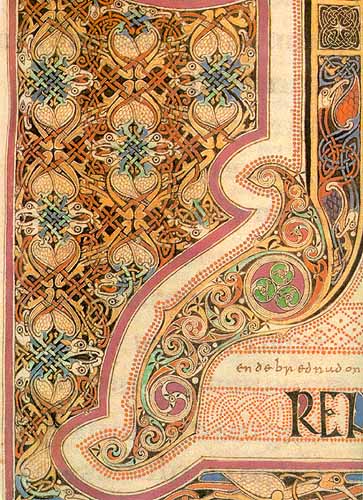
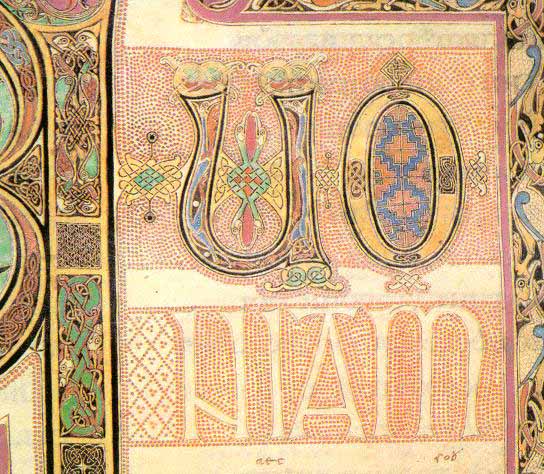
One very distinctive form of ornament is used to
more striking effect in the Lindisfarne Gospels than in any other
insular manuscripts - the technique of applying tiny drops of red lead
to form backgrounds, outlines or patterns. The initial page of St.Luke
has 10,600 dots, experimentation suggests a rate of 30 dots per minute
- thus would have taken a minimum of six hours' hard work!
Eadfrith had one small idiosyncrasy which is
apparent on several of the major decorated pages which has not been
satisfactorily explained. Apparently deliberately, he several times
either left a small part of the design unfinished or introduced into it
a detail at odds with the remainder of the page. There are some schools
of thought that believe he died leaving the work unfinished, but some of
these imperfections are at the beginning of the book and are so small
that it seems unlikely that they were the results of major interruptions
to the work. It seems more feasible to suppose that Eadfrith was
practising the humility of avoiding absolute perfection in the mammoth
task which he had undertaken.
We are indebted to the late Janet Backhouse who supplied the text for our Gospel Page and gave
permission to use the images in her book "The Lindisfarne Gospels" published in association
with The British Library by Phaidon, Oxford - ISBN 0 7148 2148 9.
Available from: