| ATTRACTIONS OPEN DAILY FROM APRIL UNTIL NOVEMBER Y2020 ( Etal castle from easter ) |

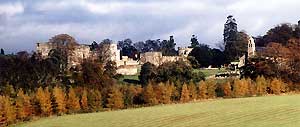 Ford Castle |
Ford & Etal Estates
Ford and Etal Estates are situated midway between Newcastle-upon-Tyne and Edinburgh, the Estates of Ford and Etal lie just 4 miles from the Scottish Border in the heart of the English Border country.Framed by the Cheviot Hills to the south and the famous River Tweed to the north, the estates' 15,000 acres of farmlands and picturesque villages present an image of rural tranquillity. The scenic environment and abundance of wildlife provide an ideal setting for walking, cycling, horse-riding and fishing.
Historically, Ford and Etal were two separate estates owned by different landowners. In the days of bloody Anglo-Scottish warfare, the area saw turbulent times with cross-border strife and neighbour fighting neighbour. Certainly, the Heron family, Lords of Ford and the Manners family, Lords of Etal in the 14th century were bitter rivals. It was not until the 20th century that the two estates became united when in 1907 the first Baron Joicey, a successful mine owner from Durham purchased Ford and then in 1908 purchased Etal.
Set astride the valley of the River Till, the only English tributary of the River Tweed, the estates comprise the villages of Ford and Etal which are situated about 3 miles apart with the hamlet of Heatherslaw snuggled in between.
| Heatherslaw Mill |
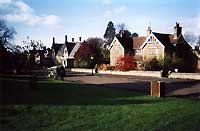 Ford Village |
Ford Village is set on a hillside overlooking the Till Valley. During the latter half of the 19th century Louisa Anne, Marchioness of Waterford, on inheriting Ford Estate on the death of her husband in 1859, set about transforming it from a group of hovels to a well-ordered village and peaceful haven.
Lady Waterford Hall, situated in the centre of the village, was commissioned by Lady Waterford in 1860 as the village school, a role which it held until 1956. The walls are decorated with large murals depicting schoolchildren, parents and people who lived and worked around Ford at that time as characters from well known Biblical stories.
 Stunning Views |
Across the road from the Hall enjoy refreshments at the Estate House Tearoom or at Ford Village Shop - both venues offer indoor and outdoor seating. At the top of the street is Horseshoe Forge with its stone horseshoe doorway, a blacksmiths forge until the 1970s and now home to an antiques gallery offering a range of antiques, collectables, vintage clothing and furniture along with John Marrin, seller of antiquarian, rare and second-hand books. Ford's two oldest buildings, situated on the outskirts of the village, are Ford Castle and the Church of St.Michael and all Angels. Parts of each date back to the 12th century. Today, Ford Castle is leased to 'Ford Castle Adventure' and offers educational and adventure holidays to schools from the UK and Europe. It is not generally open to the public. Visitors are, of course, most welcome to visit the church, now a Flodden Ecomusuem site. The resting place of Lady Waterford can be seen near the church entrance, and stunning views can be enjoyed across the valley to the Cheviot Hills.
| Lady Waterford Hall |
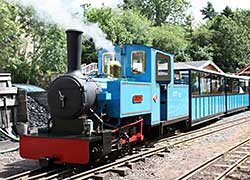 Steam Engine 'Bunty' with blue carriages |
Following the road out of Ford for about 1 mile you will find the hamlet of Heatherslaw. Here you will find the 'Heatherslaw Light Railway' and on the opposite bank of the River Till, the 'Heatherslaw Corn Mill. Just up the hill between Heatherslaw and Ford you can visit 'Hay Farm Heavy Horse Centre', home to magnificent Clydesdale horses and a small museum displaying agricultural artefacts.
The 'Heatherslaw Light Railway' operates a 15-inch gauge light steam railway which carries visitors from Heatherslaw along the banks of the Till to Etal Village. With the train drawn by the light steam engine, 'Bunty', what a delightful way to arrive in Etal!
An iron foot bridge, built around 125 years ago as a 'temporary' crossing leads the visitor to 'Heatherslaw Corn Mill'. This restored Victorian mill is England's most northerly working water mill producing stoneground wholemeal flour seven days a week during the season. Open to visitors here is an opportunity to see how the river is harnessed to power the original machinery and flour is produced using traditional methods. Fresh Mill produce can be purchased in the adjoining Gift Shop. The Heatherslaw Tearoom, located in the mill's granary, offers a warm welcome and a tempting range of traditional home baking and snacks.
Just across the road is a Visitor Centre with information about Ford & Etal as well as North Northumberland and the Scottish Borders. Cycles are available for hire enabling you to take time to enjoy the splendour of the area on two wheels. Don't miss Handmade at Heatherslaw, making and selling original papercut art and hand-made jewellery.
| Heatherslaw Light Railway |
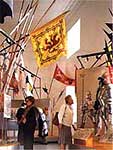 Etal Castle |
Etal village is characterised by its pretty whitewashed cottages and mixture of thatched and slate roofs.
In the centre of the village, call at the Lavender Tearooms, village shop, plant centre and Post Office where locally sourced food, gifts and plants are available, and refreshments are served daily in the tearooms or the gardens outside. Opposite the Tearoom is the Black Bull, the only thatched pub in Northumberland. Having undergone major refurbishment it will be open again from May 2018, serving lunchtime and evening menus. A short walk down towards the river leads to the 'Old Power House', now the workshops of Taylor & Green, designers and makers of high-quality furniture.
At the far end of the village stands the remains of Etal Castle which is looked after by English Heritage. The famous and very bloody battle of Flodden Field was fought nearby on 9th September 1513 during which James IV of Scotland was slain - the last British monarch to be killed in battle. Having played a major role, Etal Castle's award winning exhibition and audio tour is a most appropriate venue to gain more insight into these life in these terrible and turbulent times.
| LINKS |
|
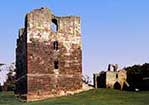 ETAL CASTLE |
| LINKS |